
How many of the UK’s top 50 law firms use Google Ads?
Thursday 17th July 2025
In today’s competitive legal landscape, digital visibility is increasingly important and for many firms, that means investing in online advertising.
Tela delved into Google’s Ad Transparency Center to find out which law firms are running paid ads and what topics they’re targeting.

Key findings:
Out of the UK’s top 50 law firms, 19 have active Google Ads accounts, while the remaining 31 show no visible ads under their names. Among the firms engaging in paid search advertising, the campaigns span a wide variety of topics including careers and recruitment efforts to more specific legal services such as family law, personal injury and even niche areas like asbestos claims.
Number of ads by law firm
Here’s a visual comparison of the most active firms based on the number of ads:
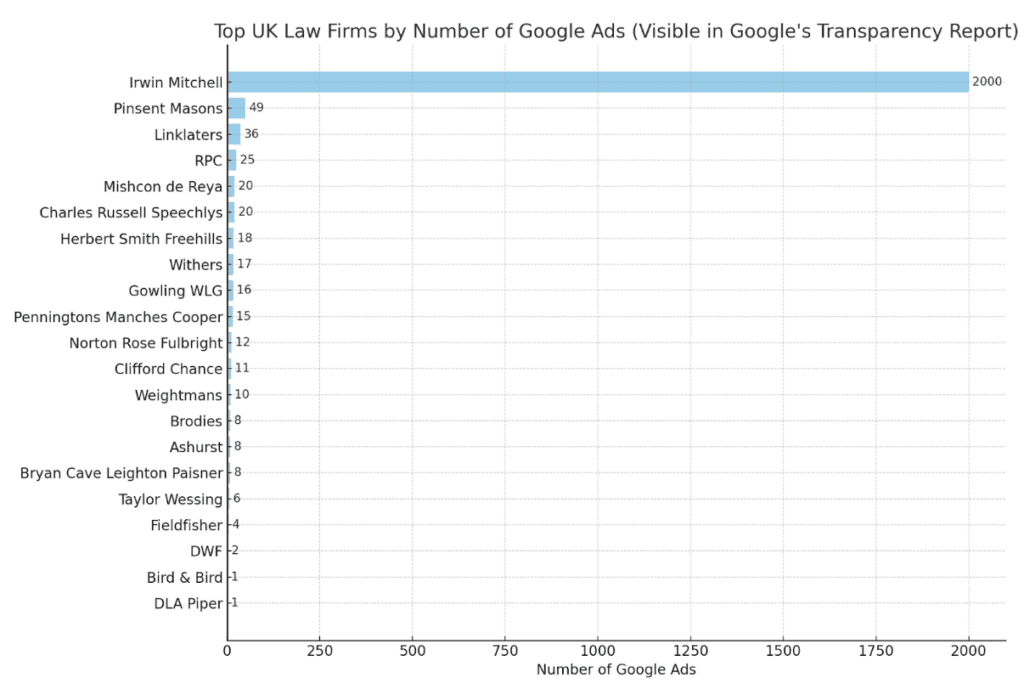
(Data Source: Google Ads Transparency Center)
What are each law firm promoting?
While only a portion of the UK’s top 50 law firms are using Google Ads, those that do are running strategic campaigns. Here’s a breakdown of the most notable advertisers and what they’re promoting.
Irwin Mitchell
Irwin Mitchell stands out by a large margin, with over 2,000 active ads. These span a wide array of legal topics, suggesting a well-funded and highly targeted digital strategy aimed at attracting both clients and talent across multiple practice areas.
Pinsent Masons
With 49 ads, Pinsent Masons is another major player in the space. Their campaigns focus on legal support services and career opportunities, indicating a dual effort to build brand authority and attract new recruits.
RPC (Reynolds Porter Chamberlain)
RPC has taken a broad approach, running ads in more than nine distinct categories. These include construction law, media and entertainment, cybersecurity, financial services and sports law showcasing the firm’s versatility and broad client base.
Mishcon de Reya, Withers & Charles Russell Speechlys
Mishcon de Reya, Withers and Charles Russell Speechlys have developed diverse ad portfolios. Their campaigns cover everything from family law and divorce to trusts, estates and high-net-worth advisory, targeting a wide range of private client needs.
Fieldfisher
Fieldfisher’s ads take a more focused approach, targeting individuals affected by asbestos exposure. Their campaign offers free legal advice, positioning the firm as an advocate for victims seeking compensation.
Taylor Wessing
Taylor Wessing is one of the few firms exploring cutting-edge territory, with ads centered on artificial intelligence (AI). This points to a strategic effort to position themselves at the forefront of technology-related legal services.
Most common ad topics among UK law firm
By analysing the firms with ads, a few key advertising themes emerge:
| Ad topic | Appears in Ads from | Popularity |
|---|---|---|
| Careers/Recruitment | Clifford Chance, Pinsent Masons, DWF, RPC, Linklaters | Very popular |
| Family Law & Divorce | Withers, Penningtons Manches Cooper, Brodies, Weightmans | Very popular |
| Real Estate | Bryan Cave Leighton Paisner, Gowling WLG | Moderate |
| Technology & AI | Taylor Wessing, RPC | Moderate |
| Personal Injury | Penningtons Manches Cooper, Irwin Mitchell | Very popular |
| Asbestos Claims | Fieldfisher | Niche |
| High-Net-Worth & Estates | Charles Russell Speechlys, Withers | Moderate |
| Construction Law | RPC | Moderate |
| Cybersecurity | RPC | Moderate |
Firms with no ads
Surprisingly, some of the most prestigious names in law show no active advertising campaigns.
This likely reflects a deliberate branding strategy. These firms serve high-end corporate clients and may rely more on long-term relationships, referrals and reputation than online visibility.
Why does this matter?
In an age where client acquisition often starts with a Google search, paid ads can be a powerful tool for visibility especially for firms offering consumer-facing services like family law, personal injury or estate planning.
At the same time, corporate-focused firms appear more selective, preferring organic marketing and direct client relationships over mass-market advertising.
Conclusion
The use of Google Ads among top UK law firms is far from universal, but it’s clearly growing. Whether it’s to attract talent, promote niche legal services or win new clients, more firms are exploring paid visibility online.