
Answer engine optimisation for law firms
Wednesday 29th July 2026
Search engines are undergoing a fundamental shift driven by AI. Instead of navigating pages of search results, users are increasingly receiving direct answers from AI systems. This means visibility for law firms is no longer just about ranking in search results, it is about being selected as part of the answer itself.
What is answer engine optimisation (AEO)?
AEO is the practice of structuring and presenting content so that it can be understood, extracted and trusted as an answer for AI systems. This includes AI assistants such as Chat GPT, co-pilot and Claude, as well as AI answer engines such as Google AI overviews.
Users are becoming less reliant on searching for law firms and browsing multiple websites to find information themselves, they are expecting consolidated, direct answers from AI systems.
Why AEO matters for UK law firms
For law firms, this shift is changing how potential clients discover and evaluate legal advice. Clients are increasingly asking AI tools complex, situation-based legal questions and expecting immediate guidance on what to do next.
Users are no longer typing short keywords, they are asking questions such as “Can I sue my employer for unfair dismissal?”, “What are my rights if I’ve been arrested?”, or “How is child custody decided in the UK?”. These are the kinds of questions users are increasingly putting directly into AI assistants when they need immediate clarity.
This has created a significant shift in how trust is formed online. If your firm’s content is used as part of that AI generated answer, you achieve early positioning where your expertise is seen before your competitors are even visible, building authority and credibility.
Example of AI overview
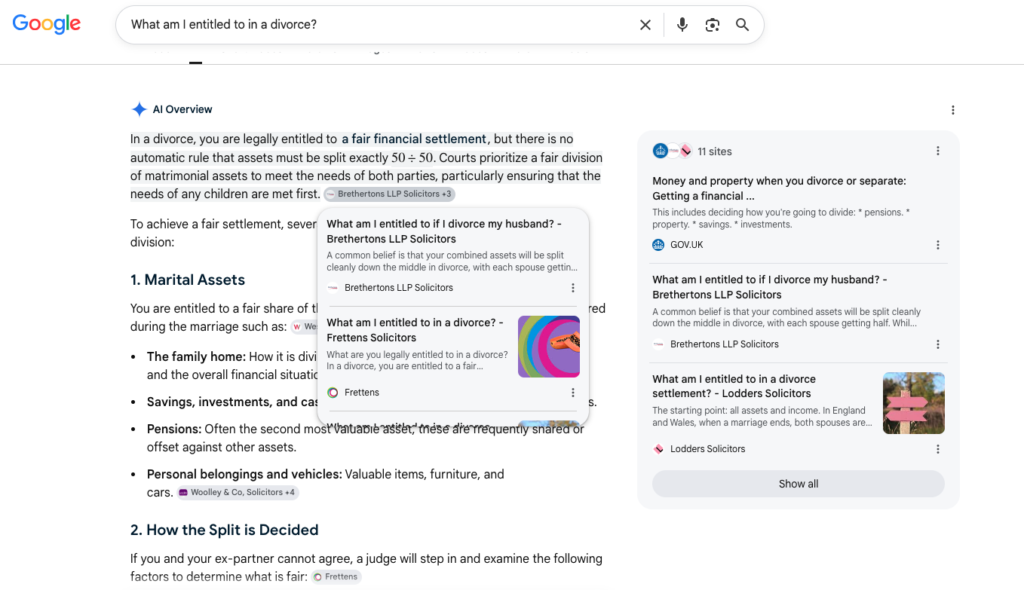
The screenshot above shows how Google’s AI Overview responds to the search query “What am I entitled to in a divorce?”. Rather than simply displaying a list of websites, Google generates a consolidated answer using information pulled from multiple legal sources such as Brethertons LLP Solicitors, Frettens Solicitors, Lodders Solicitors and GOV.UK.
Being featured in AI-generated answers is not only a visibility opportunity. According to Google, users who click through from AI overviews tend to be more engaged and spend more time on websites; suggesting these visits may be more valuable than traditional search traffic.
Final thoughts
As AI continues to reshape how people search for information online, law firms need to think beyond traditional SEO.
By creating authoritative content, answering client questions clearly and structuring information in a way that AI can easily interpret; law firms can improve their chances of appearing in AI-generated answers and reaching potential clients earlier in their decision-making journey.
Want to learn more about preparing your website for AI-driven search? Read our guide on optimising your website for AI search.